What to use when you cannot play audio
On the LRT, in a meeting or beside a sleeping child, sound is not possible.
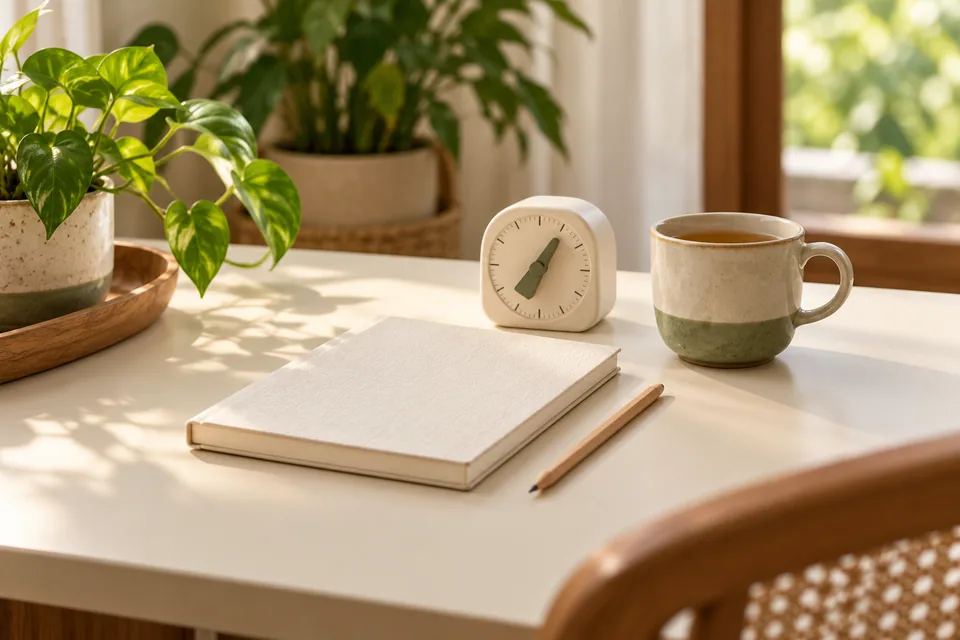
Everything on Blissful works without sound. The guides are written, the planners are visual, and the meditation timer can be watched on the screen.
So if you cannot play audio, you have not lost anything. You just need a plan for the quiet version.
When is audio hard to use?
Plenty of everyday moments rule it out. A packed LRT carriage, a shared bedroom, a hospital waiting area, a prayer room, a warehouse floor or a shift break with no headphones.
Sometimes it is not the place but the person. Some readers are deaf or hard of hearing, and others find a voice distracting. Reading can be calmer, and that is a fair preference.
What can I use instead of a recording?
Start with something you can read once, then do without looking at the screen.
- A written guide such as what is meditation, which explains the idea in plain words.
- The meditation timer, which you can watch or glance at.
- A planner such as the evening wind-down planner, which builds a routine on paper.
- The ideas in meditating without an app, which need nothing but a chair.
Try this: a silent minute you read once
Read these steps through, then put the phone down and do them. You do not need to check them again.
- Sit comfortably. Feet on the floor, hands resting.
- Let your eyes close, or look softly at one spot.
- Feel your breath in the place where it is easiest to notice.
- When a thought pulls you away, think “thinking” and return to the breath.
- After about a minute, look around slowly and notice three things you can see.
If your mind drifted ten times in that minute, you practised ten times. That counts. Count the minute by feel, or use the timer if it helps you relax.
How do I know when time is up without a sound?
Choose a cue that does not need audio.
- Watch the timer on the screen, with the phone face up on your knee.
- Use a vibration alert if your phone offers one.
- Set the length to something short enough that it feels easy to finish.
A shorter practice also stops you checking the time. One minute is plenty to start.
What if I want transcripts or captions?
Not every resource has them. Before you rely on one, our guide on checking whether a guide or app works without audio gives a quick test you can do in two minutes.
Fitting it into a Malaysian day
Pick a pocket that already exists. The five minutes while the kopi cools, the wait at a clinic, the pause before you open the family WhatsApp group.
In a noisy home, you do not need silence. The sounds around you can be what you rest your attention on, and reading first helps you know what to do.
If a practice brings up distress, dizziness or painful memories, it is fine to stop. Talking to a doctor or counsellor is a good idea, and our support page lists where to start.
How do I use a focus timer without sound alerts?
A focus timer does not need a bell. You can use the screen, a silent phone setting or a paper cue instead. Try these.
- Use the meditation timer with the sound off and keep the page open where you can see it.
- Set a phone timer on vibrate and rest the phone face down on the desk or your leg.
- Write the finish time on a sticky note, such as “stop at three forty”, and glance at the clock.
- Use a visual cue, like moving a paper clip along a row of boxes each time you finish a step.
Before you start, tell the person next to you what you are doing, so a silent glance does not look like switching off.
If you are Deaf or hard of hearing, a vibrating wearable or a flashing phone screen can work as the alert. Check that your device settings allow it, then do a short test run.
Pick the finish time first, then work. That way you never depend on a sound to know it is time to stop.
How can I follow a demonstration through text and still images?
A demonstration is only a set of steps that someone shows. You can follow it from words and pictures if each step is clear and in order.
- Look for numbered steps and read them once before you try anything.
- Match each step to a still image or a drawing, if the page has one.
- Do one step, then stop and check it against the picture.
- Write down any step you are unsure about and return to it.
If a page has only a video, look for a written version, a transcript or captions. If there is none, you may ask the author to add one, and our guide on reporting a confusing translation shows how to describe a problem clearly.
For a movement or breathing practice, read the steps slowly in your head and do them one at a time. At a mamak table, one friend can read while another tries it.
You have followed the demonstration when you can describe each step in your own words. That counts, even if you never pressed play.
Where to go next
If you would like to hear a voice at another time, Sadhguru’s free seven-minute guided meditation in the Miracle of Mind app is optional, and this page is complete without it.
You can find more in our accessibility and digital confidence guides.
Common questions
Do I need headphones to use Blissful?
No. The guides, planners and timer are written or visual, so they work in silence. Headphones are only useful if you choose to play a guided recording elsewhere and want privacy around other people.
Is a written practice as good as a guided one?
They suit different moments. A voice can be easy to follow, while a written practice lets you go at your own speed and use it anywhere. Choose whichever you will actually do on a busy day.
What if I am deaf or hard of hearing?
The written guides and visual tools are made for you as much as anyone. For other resources, our audio check guide shows how to find out before you start whether captions or a transcript exist.
Can I use the timer silently?
Yes. Open the meditation timer and watch the countdown on screen. If you want to be told when time is up, check your phone's vibration or notification settings rather than relying on a sound.
Read next
When you are somewhere you can play sound, a short guided sit is a pleasant change from reading, and it is optional.